Archive for the ‘Jewellery Tips’ Category

NEW to the World of Precious Metal Clay (PMC)?

Thursday, March 11th, 2010

For PMC beginners the most confusing thing is, “What tools do I need?”, so here are a few suggestions to help you along the way:

PMC Suggested TOOLS:

A roller – used for rolling out the clay

A rolling surface – Non-stick as possible e.g. a glass board or polished tile

Spacers or playing cards – for getting the depth of the clay even

Cutting blade, scalpel – For getting straight edges and making your shapes.

A small lidded pot – to put filings & tiny offcuts into so you can save them for making silver clay paste or slip

Various grades of sanding pads - or get a 4 way nail filing block and strip the sides off.

Badger Balm or Olive Oil for stopping the clay sticking to your hands and tools.

Tools for Precious Metal Clay

Tools for Precious Metal Clay

FIRING METHODS:

For Hob firing, stainless steel mesh with protection net.

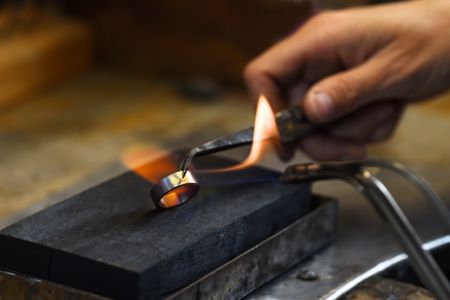
Torch firing – Handheld torch and a firing brick (asbestos substitute not a household brick )

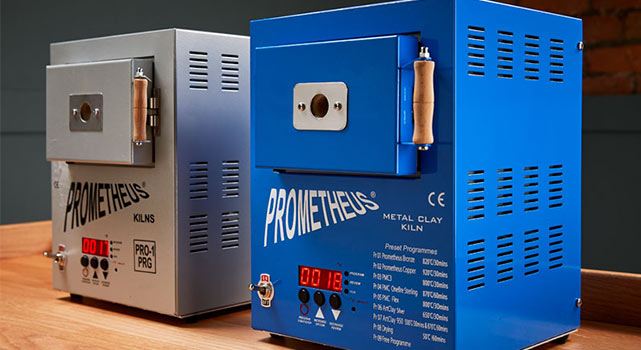
Kiln – If you can get access to a kiln then use it, the metal is normally denser and the results more consistant.

Stainless steel or brass brush – for brushing off the white post firing and leaving you lovely silver.

Silver polish & Cloth – for getting the final buffed up shine.

Some Optional Extras:

For ring making – A sliding ring guage, A wooden ring mandrel, and ring papers (to stop clay sticking to the mandrel).

For Better finishes – A small set of metal files for neatening edges quicker than sanding them down.

Long Tweezers – For holding / moving the pieces when firing

Liver of Sulpher – For antiquing or bringing out fine detail

Burnishers & ultra fine sanding pads – Post firing for a REAL shine!

Cutters & Shapers – Using pre-shaped cutters e.g. hearts will same time and give you more consistant shapes

Tiny drill bits – you can twist them in your fingers to drill through the unfired clay & make jump ring holes & hanging points.

Texture Mats/plates – Roll the clay out on these and you’ll have fabulous patterns straight away!

Letter Stamp Set – For stamping words into unfired (rubber stamps) or fired clay (metal stamps).

Why not check out our ready-assembled Starter Precious Metal Clay kit packed with everything you could possibley need to get started with PMC. Alternatively, if your not a PMC novice click here to view our full range of silver clay kits including our Art Clay kit and complete silver clay accessories kit, tumbler kit and tool kit.

Starter Kit for Precious Metal Clay

Starter Kit for Precious Metal Clay

Techniques, tools & processes used when filing precious metals

Tuesday, August 4th, 2009

We’d thought we’d look at some of the essential techniques, tools & processes used when filing precious metals – gold, silver & platinum.

Filing is an essential technique in jewellery making, and although simple in concept following proven practices combined with the right equipment and tools, ensures the job becomes a breeze.

Filing precious metals
Filing is used in jewellery making to remove excess metal, even out surfaces, smooth or to shape, form and texture pieces.

The actual files come in a variety of shapes, grades/cuts and sizes. The shape of the file you choose will depend on the job you are completing i.e. flat files are used for straight edges or convex curves e.g. the outer edge of a disc, and curved files are used on concave curves – e.g. inside of rings.

The cut describes the arrangement of teeth and therefore the amount of material the file will remove and the surface finish it will leave. The most often used, and useful file is a medium cut 2 file, (cut 0 = course, Cut 4 = fine) this general purpose file removes material quickly, and leaves only light markings which can be easily removed. 

Common types of file types
In terms of types of file, both needle and hand files are the most commonly used in jewellers workshops.  The common shapes of file are Flat files – a general use file for use on flat surfaces and outside curves, Square files for use in grooves or inside angles, Three square files for tight angles and difficult to reach areas, Round files for inside curves, Half round files for inside curves, Knife files for limited access corners, Crossing files for inside curves, Safety back files ideal for tight angles as serrated edge are only on one side.

Hand files - Range of over 150 available

Hand files - Range of over 150 available

Fitting a file handle
Needle files have an integral handle; however hand files often require a handle to be fitted. To fit your handle place the file in a vise with the ‘tang’ (where the handle is fitted) pointed upwards, then heat the tang until red hot ensuring you direct the flame upwards. Push the file handle onto the hot tang allowing the it burn into the handle. Then tap the handle with a mallet until the handle is secure.

Filing techniques for a straight line
When filing ensure that the metal is secured, as an unstable bench peg/metal will lead to inaccuracies and mistakes.  When filing a straight line use long strokes, applying pressure on the forward stroke. Make sure that the file is level and that you watch the metal to ensure accuracy plus allowing the jeweller to continually assess the pressure/placement of your next stroke. When filing you should work at a steady pace, as an aggressive technique increases the chance of inaccuracy. Many jewellers mark there metal as a guideline to measure progress and to see where they need to file.

Filing techniques for curves (convex)
With a flat faced file place the file on the metal and push forward using a sweeping action that follows the curve, ensuring the file is level. Use marks to guide the filing process, and check the surface whilst filing.

Files – an essential jewellery tool
Skilled filing is a key technique that once mastered gives the jeweller great control over shaping metal and forming designs. However initially it takes practice, concentration plus a level of intuition to ensure accurate lines or curves are achieved.  A complete jewellery tool kit will include a full selection of files – both needle and hand, of all shapes and sizes and cuts, and become some of the most used tools at the bench.

Forming Tools & Equipment for Jewellery Making

Friday, June 19th, 2009

If you’d like to make a comment about this article, or post a question please click here

Forming metal is an essential part of jewellery making, and as a process the level of skill involved is often overlooked.  Forming refers to any process that maneuvers metal into the desired shape or design. Unlike many other skills in jewellery making forming is more a combination of a range of techniques that change an objects shape, rather than one particular process. 

Under the heading of forming are processes such as bending, chasing, repousse, sinking, hammering, using stamps/dies and forging.  These processes will affect the pieces shape, thickness and often the texture of the metal being worked on.

Forming Tools
The range of forming tools available is as wide and varied as the different processes contained within the skill.  The key forming tools available are:

Mallets
The simple mallet allows the craftsman to apply direct force without stretching or damaging the metal.  The head of the mallet is softer that the metal so not to mark the surface.

Mandrels or Triblets
Mandrels or Triblets are used for forming shapes, and are most associated with rings or bangles.  Mandrels are available in a variety size and shapes, and in both steel & wood.

Hammers
Hammers can complete a variety of jobs from stretching the metal, polish/smoothing or adding texture. Jobbing hammers are ideal for general use and metal forming. The planishing hammer is used for smoothing, shaping and polishing metal.  Riveting hammers are designed with a small head for detailed rivet work. Raising, bossing and chasing hammers are used in the different stages of forming.

Doming Blocks & Punches
Doming blocks & punches are the ideal way of shaping metal and making domed, shaped pieces or hollow beads. Pieces of circular metal/discs are place over the hollows of a doming block, and then using punches and a hammer the metal is formed into a shape. 

Steel Blocks
Steel blocks provide the ideal flat surface for working, flattening sheet or wire or to support work as it is raised or forged, riveted or textured.

Swage Blocks
Rather like doming blocks, Swage blocks help form metal into tubes, curves and channels.  Different blocks will allow different shapes and sizes to be formed.

Sandbag / Grit filled Cushion
These bags provided support whilst you work and form your piece. They help keep your work firm and in place whilst working.

Pliers
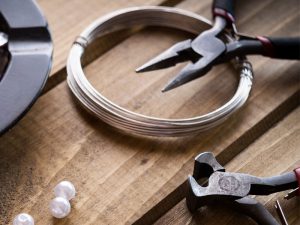
Pliers have a multitude of uses but they are the most basic tool for holding/gripping, forming and shaping wire.  Having a basic selection of needle nose, round nose, flat nose, half round and a pair of parallel action pliers, will give the jeweller the flexibility to complete most jobs.

Stakes
Often used by silversmiths, the metal is placed over the stakes (usually clamped independently into a vice) and hammered to achieve the shape required. Various shapes can be achieved by using different stakes.

Files
Files are essential for removing excess material, and fine tuning and shaping your piece.  The different sizes available allow the jeweller to work large areas or at a more intricate level. To start with buy a selection of shapes containing round, square, triangular, half round and warding.  Plus consider the cut ranging from 0 the coarsest, to 6 the finest.

Draw plates
Draw plates are most commonly used to reduce the size or change shape of wire. Each plate has a series of holes through which the wire is passed through, this then changes the size of the wire. The holes in the plate are of decreasing size allowing you to continue draw down the wire to the required size.

Rolling mills
These larger machines often seen in jewellers’ workshops are ideal to reduce the thickness of sheet, or help decorate sheet. If used with Square and D shape sections rolling mills can be used to form or shape wire. 

This selection of forming tools & equipment allow jewellers, and metalsmiths to create any number of shapes, textures and patterns.  As with all jewellery projects the range of forming tools jewellers have will start with the basic i.e. pliers, hammer and perhaps a doming set, and then expand as their projects demand.

Forming Tools

Forming Tools

CLICK HERE TO MAKE A COMMENT, POST A COMMUNAL QUESTION OR ASK THE COOKSON TEAM A QUESTION

Rolling Mill – Milling Silver & Gold Sheet & Wire

Tuesday, May 12th, 2009


If you’d like to make a comment about this article, or post a question please click here

STOP PRESS – We’ve just dropped the price of ALL our rolling mills, and to co-inside with this new offer we thought…
 

Rolling Mills – Basic Concepts

Rolling mills are one of the more common jeweller’s tools seen in small and medium sized workshops. In essence the rolling mill is a simple machine that shares many traits with a mangle. The traditional jewellers rolling mill will have steel rollers, so that when metal is passed between them it become compressed, changing the gauge or even shape of the piece. For example changing a circle into an oval shape.  


As a rough guide when halving the thickness of sheet you will double the length (if rolling in one direction). Rolling should be a gradual process, and the resulting compression of the metal will mean that the metal will work harden. Therefore in between each stage of rolling, the metal will need to be annealed.


In addition to rolling sheet many of today’s mills have the ability to roll wires into square or D shape sections – ideal for creating a tapered or shaped effect.


Smaller rolling mills are the most practical for the small or home workshop with one pair of rollers. Larger and automatic mills are available for the larger workshop, but with all mills they must be secured to a firm and steady surface – and many manufacturers recommend a dedicated stand bolted to the floor.


Rolling Sheet

First ensure your sheet is prepared for rolling i.e. it’s has been annealed, and cleaned, and importantly dried. Then adjust the width of the rollers, many machines have a dial gauge to aid precise rolling gap measurement. As a physical test try pushing the sheet between the rollers. If the sheet passes through, the rollers should be adjusted until it will not pass between them.


Once the rollers are in the correct position the mill is ready to roll down the metal. The sheet should be supported in one hand, whilst the other turns the handle, thus drawing the sheet through the rollers.  The sheet should be caught as it comes through, and thickness checked using a vernier/calliper.  Then re-roll to achieve the required thickness.


Rolling Silver circles to create Ovals

To create an oval take a silver disc, set the rollers as you would for rolling sheet, and then feed the disc through. Once the disc has been through the mill, check the thickness and length of the piece using a vernier/calliper, and repeat the process as necessary. When feeding the oval through the mill again, ensure that it is fed through the rollers in the same direction to ensure it elongates the oval.


Shaping Wire

Using a rolling mill with square grooves allows jewellers to shape (often into a square shape) and taper round wires. Before starting the process the wire must be annealed, pickled and cleaned and dried thoroughly. The wire is then pushed between the square grooves and the handled turned so the wire is drawn into the grooved section of the rollers. This then shapes the wire. To ensure the required shape is achieved turn the wire each time by 90 degrees.


Formed D Shape wire

Rolling mills with D shape channels allow D shape wire to be formed, and follow similar principals as shaping. The wire is fed through the D shape section rollers and once the wire has passed through check the thickness. If it is not of the required thickness repeat the process.


Best practice when using rolling mills

When using a rolling mill consider the following best practice hints & tips:

           Always use dry metal – any dampness will leave marks on the rollers
             – and risking pitting.

           Roll metal gradually, as too much pressure may result in the piece�
            cracking when next annealing.

           Keep your mill well maintained and oiled.

           Remove any marks on the rollers. Clean with a damp cloth and�
            acetone to remove dirt. For more stubborn marks carefully remove
            with fine wet and dry paper and fine steel wool.

           Keep the mill covered when not in use, to protect the rollers
            from workshop debris.

Click here to view our range of rolling mills

Click here to view our range of rolling mills

Rolling Mills are one of the more expensive jeweller’s tools, and although simple in nature the mill can be put to many uses. When buying a mill, like many tools you should buy the best mill you can afford, with the better mills being more robust and having heavier and stronger rollers.

CLICK HERE TO MAKE A COMMENT, POST A COMMUNAL QUESTION OR ASK THE COOKSON TEAM A QUESTION

Starting & furnishing a jewellers workshop

Monday, April 27th, 2009


If you’d like to make a comment about this article, or post a question please click here

Making jewellery doesn’t require a large space or big pieces of equipment or even furniture. A selection of key workshop pieces combined with basic hand tools provides everything for the first workshop. Cooksongold.com provides a full range of jewellery tools - everything from basic hand tools, pre-packed tool kits, consumables, larger machinery right through to the professional jewellers bench.

Your first workshop
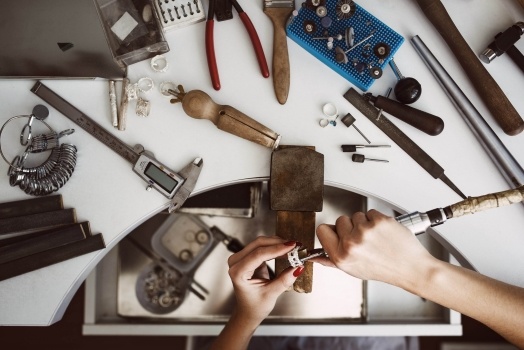
Often the beginner or student will start making jewellery on ‘normal’ desk, worktop or even kitchen table!  Adapting the table can be easily be achieved by clamping a G clamp bench vice or anvil.  The jewellers peg/pin can then be held in place securely giving a simple, yet sturdy place to work.

Work Bench

Work Benches - Click here

The peg is perhaps the most vital part of any setup allowing the jeweller to work quickly and efficiently. This wedge or triangle of wood supports the piece, holding it in a notch or v shape insert. This holds the piece rigid, allowing the jeweller to saw, cut, & file. 


If adapting an existing desk, the desk should be elevated, so that the working area is at mid chest level when the jeweller is sat upright, thus allowing maximum control of your tools and metals.


Let there be light and ventilation

Although normal desks can be adapted, two factors must be in place when setting up your ‘bench’ – light and ventilation. The work area needs to well ventilated to ensure a safe working environment combined with good bright and direct lighting. Natural light can be complemented by adjustable lamps ensuring that no shadow falls over your piece from the jeweller or the equipment.

Workshop lighting

Workshop lighting - Click here

The professional jeweller’s bench

The traditional jeweller’s bench is a purposed designed and provides the perfect working area for any project. Often mistakenly seen as expensive luxury, a good bench will last you a lifetime and most importantly will help in improving your technique. Benches are higher than a normal desk (mid chest level if the jeweller is sitting uptight) ensuring that the jeweller does not stoop to work. Most benches have the semi circle cut out ensuring that you can sit close to the to the work, and with the aid of a bench skin collects scrap and protect the jeweller from hot or sharp objects.


Organising jewellery tools  

Keeping a workshop tidy, and the tools organised will help the jeweller when working, creating an efficient working environment. Both tools & materials should ideally be kept close to the bench, with the aim of trying to keep all materials within arms reach. Practically many of the basic jewellers tools will be actually left on the bench – Pliers, files, cutters, tweezers are used so often that they can be left on the work top for immediate access. 


As a large part of jewellery making involves heat often a section of the bench will be dedicated to the equipment needed for soldering. Often the soldering area will be based around the placement of a torch, with the soldering block placed alongside a borax cone and dish.


For other materials such as jewellery findings, settings, and metal, storage containers should be used. These ideally have sliding draws to allow you to split different carats, sizes or types of findings.

Storage

Storage - Click here


Once the workshop is established all that remains to be added is the essential basic selection of popular jewellery tools such as files, saw & saw blades, emery & polishing sticks, pliers, cutters, verneirs along with forming tools and heating/soldering equipment.

CLICK HERE TO MAKE A COMMENT, POST A COMMUNAL QUESTION OR ASK THE COOKSON TEAM A QUESTION

Creative Freedom with NEW Art Clay Silver 650

Thursday, April 16th, 2009

If you’d like to make a comment about this article, or post a question please click here


We’ve all been fans of silver clay since we launched our range of Precious Metal Clay (PMC) last year, but since this launch we’ve been inundated for requests for Art Clay.
We’re now pleased to say that Cooksongold is stocking both Art Clay Silver 650, alongside Precious Metal Clay (PMC).


So what is ART CLAY? Art Clay is a precious metal clay which looks and feels like ordinary sculpting or porcelain clay with fine particles of pure silver mixed with a
non-toxic organic binder. The binder burns out during firing, leaving a pure silver item. It is an amazing material which gives the artist the freedom to create an object in clay, which when fired results in a pure, fine silver piece. The skill set required is more that of a model maker/sculptor/designer than those normally associated with a professional jeweller.


This Art Clay is known as Silver 650, simply because it can be fired at 650°C.
In fact at this low temperature it can be fired with sterling silver, dichroic glass and natural stones. This 650 version of Art Clay is slightly brighter than other clays. It shrinks by around 8% to 9%. Fire at 650°C for 30 minutes or 780°C for five minutes. Only use the higher temperature if the piece does not include sterling silver or glass. The object must be dry before firing.


Our Art Clay range includes :

Art Clay – the main product used for creating your piece.

Art Clay Slow Dry Clay – ideal for intricate modelling,

 Art Clay Paste – for gluing parts together and repair work & for texturing

 Art Clay Syringe – used for fine decoration

 Art Clay Paper – great for folding or embellishment

 Silver Oil Paste – used after firing to repair cracks or glue fired pieces together


If you are new to Art Clay why not take a look at our Art Clay Starter kit which includes clay, DVD and a 12 page instruction book plus a selection of essential tools all for only £36.95!

CLICK HERE TO MAKE A COMMENT, POST A COMMUNAL QUESTION OR ASK THE COOKSON TEAM A QUESTION

Art Clay Starter Kit, click here

Art Clay Starter Kit, click here

Essential Guide to Pliers

Thursday, April 2nd, 2009

If you’d like to make a comment about this article, or post a question please click here

Whether you are just starting out in the trade or are seasoned jeweller your bench pliers will always be close at hand.  There is now an almost bewildering range of pliers available, all with their own character, and use.  With all these types available, we thought it would be worth  reviewing the most popular types – particularly as this month we have 10% off our best selling pliers !


Round Nose Pliers

Round nose pliers have round tapered jaws and are ideal for shaping wire into loops curves and bends, and are probably most often used for making circles or jump rings.   

Round Nose Pliers - 10% off!

Round Nose Pliers - 10% off!

Half Round or Ring Pliers

Half round pliers are commonly used for working with rings, bending wire/sheet into a circle without leaving marks.  The flat jaw enables the jeweller to hold the outside of the curve whilst the D shape jaw is used to form the curve on the inside. 

Half Round Pliers - 10% off!

Half Round Pliers - 10% off!

Snipe Nose or Chain Nose Pliers

Snipe or Chain nose pliers are ideal for those detailed jobs.  The flat tapered jaws means they are perfect for manoeuvring pieces into place, attaching jump rings, and fine wire work.  For those who are keen beaders snipe nose pliers can also be used for closing crimps and attaching bead caps.  In addition Snipe Nose pliers are  ideal for making angled bends.

Snipe Nose Pliers

Snipe Nose Pliers - 10% off!

Flat Nose Pliers
Flat nosed pliers are available in a range of sizes and are used to bend sharp corners in wire and sheet, plus are ideal for holding items flat, straightening wire and can be used to open and close jump rings.

Crimping Pliers

Crimping pliers are designed specifically for securing crimp beads. Some jewellers will simply use a pair of snipe or flat-nosed pliers to flatten & close the bead.  However crimping pliers make this job easier and give a more professional, smooth and unobtrusive finish.


Side Cutters / Top Cutters

Side cutters & top cutters are used for cutting wire and sheet in restricted areas. 


Split Ring Pliers

These pliers are used to open split rings easily and quickly.  Simply place the bent nose in the centre of the ring and add pressure. The split ring will then easily slide apart.


Parallel-Action Pliers

The unique box joint on the pliers keep the jaws parallel as they open and close. Parallel pliers are ideal for all forming work e.g. straightening sheet and thick wire.  Choose parallel-action pliers when you need to hold an object securely whilst applying pressure.

 Parallel Action Pliers


Savings on our best selling pliers at cooksongold.com

Our range of red handled pliers offer good quality at a great price and many types are  now discount  - click here to view our latest low prices.


Got a question about pliers, or have you got your own favourite not covered here ?  Why not post a comment.  Click here

Gemstones for Jewellery making

Friday, March 20th, 2009

If you’d like to make a general comment regarding this article or post a question to the Cookson team please click here

With the launch of our new range of gems, pearls and Semi Precious Stone Chips this month we thought we’d take a look at the process of selecting stones using colour.


The Earth yields up a rich variety of gemstones that can be used in jewellery making, with every hue and colour imaginable available to incorporate into stunning pieces that will compliment any outfit. The choice of which gemstone to include in a piece is purely down to the individual and is subject to all kinds of influences including birthdate, fashion or even superstition.

Click here to see our full range of gems

Click here to see our full range of gems

Birthstones are a good place to start. Each zodiac sign has a particular gemstone associated with it, and giving someone a piece of jewellery that incorporates that stone shows the recipient that much more thought has gone into the piece. The gemstones range from the lavish such as sapphires, emeralds and rubies, to the more subtle like moonstone and lapis lazuli. Because of the sheer range of gemstones available, you can spend as little or as much as you like and still have a beautiful piece of jewellery with a hidden meaning, which will be cherished by the recipient.


Breaking down gemstones by colour is also an alternative. If you like red but can’t afford to buy a high quality ruby, then you could look at cheaper alternatives such as garnets or spinel. Spinel can range in colour to a delicate pink through to a deep red and can look every bit as stunning as a ruby. Garnets offer a deeper shade of red with hints of violet and purple in them. They’re popular in eastern jewellery and can be used to produce exotic looking jewellery at a fraction of the cost of most rubies.


For blue stones, sapphires are the first choice, but even though these range in colour, quality and price, there are other alternatives. A particular favourite is the deep royal blue of lapis lazuli, which is often flecked with gold within the stone. This can produce a stunning effect with gold findings. Lapis can also be bought as beads as well as cabochons, meaning that the stone can be used in necklaces or as a setting for a ring, for example. Kunzite is another alternative that has a violet tint and is a relatively cheap alternative to precious gemstones such as sapphires.


Not strictly a gemstone but still valued highly in jewellery making, amber is a perennial favourite. Its warm, golden tone compliments silver findings perfectly and it has a honey-like lustre that is hard to resist. It can be a difficult gem to work with as it is very soft, but the results it produces are well worth the effort. Baltic amber is the most highly prized, but Middle Eastern amber can range in tone from a golden yellow to a deep red.


The most obvious green gemstone to go for is emerald, and surprisingly these can be far less expensive than you first think. Again, quality stones will cost more, but if you’re willing and capable of doing a little work to refine a lower quality stone the effects can still be beautiful. Peridot is a cheaper alternative and is a much paler green with a translucency that is extremely delicate and effective for use with small findings.


The opal carries a great deal of superstition with it, but is probably one of the most beautiful gemstones to work with. It ranges from a milky white to deep blue or even the rare ‘fire opal’, which is like a small firework captured in stone. Its ability to catch the light and produce a rainbow of colours is dazzling, and opal retains its popularity even today.


There are thousands of gemstones to choose from, and cooksongold.com carries  a full selection, ranging from emeralds and rubies right through to cheaper but no less beautiful alternatives. Don’t be afraid of including gemstones in your jewellery making – the results can be inspiring!

CLICK HERE TO MAKE A COMMENT, POST A COMMUNAL QUESTION OR ASK THE COOKSON TEAM A QUESTION

Visit the Jewellery Quarter Museum

Tuesday, March 10th, 2009

If you’d like to make a general comment regarding this article or post a question to the Cookson team please click here  

Why not combine a visit to the Cookson Trade Counter with a visit to the Museum of the Jewellery Quarter.

The Museum has a preserved jewellery workshop offering a unique glimpse of working life in Birmingham’s famous Jewellery Quarter. For more than eighty years Smith and Pepper produced jewellery from this workshop, founded in 1899. Explore this extraordinary industrial time capsule on a lively guided tour. Here you will find things left as they were on Smith and Pepper’s last working day.

The museum tells the story of jewellery making in Birmingham. The Jewellery Quarter gained its distinctive identity in the 19th century when Birmingham was known as the ‘Workshop of the World’. Today the city is still very much at the forefront of jewellery manufacture in Britain.

You can get a feel for this great industrial past and modern  jewellery trade as you wander through the Quarter’s tight-knit street, lined with jewellery shops, makers’ workshops and distinctive historic factories.

 The Jewellery Quarter Museum

The Jewellery Quarter Museum

How to find the museum:

75-80 Vyse Street,
Hockley,
Birmingham,
B18 6HA,

Telephone: 0121 554 3598

Admission is FREE!

CLICK HERE TO MAKE A COMMENT, POST A COMMUNAL QUESTION OR ASK THE COOKSON TEAM A QUESTION

Silver Clay Explained – Precious Metal Clay and Art Clay Silver

Tuesday, March 3rd, 2009

If you’d like to make a general comment regarding this article or post a question to the Cookson team please click here

Last year we introduced Precious Metal Clay (PMC), and we had a great response to the range. Designers loved PMC’s flexibility, giving them the ability to create unique designs using a new material. Throughout 2008 we had many requests to stock Art Clay Silver, so we are now pleased to be offering both ranges!

As part of the launch, this week we thought we should focus on these two great products and outline what metal clay is, how it works and the main differences between PMC & Art Clay.


Precious Metal Clay

Precious Metal Clay

Metal clays allow jewellers to work with a material that is as malleable as ordinary modelling clay but produces fine (almost pure) silver jewellery of exquisite intricacy and beauty. Once polished it has a lustre and shine that is easily comparable to cast silver and because of the development of the products over the last few years shrinkage is now no longer an issue. The type used depends on personal preference as both types have their advantages, but incorporating metal clays into your jewellery design gives you a new medium to explore with beautiful results.

What is Metal Clay?

Metal clay is a suspension of tiny particles of metal in a clay binder, which can be used to make jewellery, beads and small findings. The beauty of metal clay is that it can be manipulated in the same way as any modelling clay, but once fired the binding agents are burnt off leaving the metal form intact. Although there is a certain amount of shrinkage (between 10-15% for the more modern versions), very fine detail can be achieved, including impressions that would require casting in any other method of metalwork.


Precious Metal Clay (PMC)

Silver metal clay results in objects containing almost pure silver (also known as fine silver) which is ideal for enamelling. There are two popular brands available – Precious Metal Clay (also known as PMC) and Art Clay Silver (ACS). Precious Metal Clay was developed in the early 1990’s in Japan and consists of microscopic particles of pure silver (or fine gold powder) and a water-soluble binder which burns off during firing. The original formula of PMC (now called ‘Standard’) has to be fired in a kiln at a temperature of 898°C/650F and has a high shrinkage rate of around 30%. Two additional versions were later developed called PMC+, which can be fired at 810°C/1490F and PMC3, which can be fired at temperatures as low as 593°C/1100F. Both of these later versions of PMC have much lower shrinkage rates, allowing much finer detail to be worked into designs.


Art Clay Silver

Art Clay Silver (ACS) was also developed in Japan and is similar in consistency to PMC+. The main difference with Art Clay is that it is more suited to be fired using a hand-held torch or gas oven. Because of subtle differences in the binder components and the longer firing times, Art Clay Silver benefited from having a considerably lower shrinkage percentage – only 8-10%. This means that ACS can be worked in more detail without any loss of definition in fine work. Art Clay Slow Dry was introduced soon after, which has a much longer working time before requiring firing, allowing intricate work to be moulded into the clay with no loss of malleability.

NEW Art Clay

NEW Art Clay

Art Clay 650 and Art Clay 650 Slow Dry are now becoming increasingly popular, as not only do they have a longer working time but can be fired at temperatures as low as 650°C/1200F. This allows jewellers to incorporate glass and Sterling Silver into the designs without fear of damaging the components. The manufacturers of ACS have also introduced Oil Paste, a product only used on fired metal clay or milled fine silver, and Overlay Paste which is designed for drawing designs onto glass and porcelain. These two products have allowed the use of metal clay products to be incorporated into a whole new range of designs and mediums, expanding the potential of this product.

Metal clays allow jewellers to work with a material that is as malleable as ordinary modelling clay but produces fine (almost pure) silver jewellery of exquisite intricacy and beauty. Once polished it has a lustre and shine that is easily comparable to cast silver and because of the development of the products over the last few years shrinkage is now no longer an issue. The type used depends on personal preference as both types have their advantages, but incorporating metal clays into your jewellery design gives you a new medium to explore with beautiful results.


CLICK HERE TO MAKE A COMMENT, POST A COMMUNAL QUESTION OR ASK THE COOKSON TEAM A QUESTION