Posts Tagged ‘Jewellery Tips’

NEW to the World of Precious Metal Clay (PMC)?

Thursday, March 11th, 2010

For PMC beginners the most confusing thing is, “What tools do I need?”, so here are a few suggestions to help you along the way:

PMC Suggested TOOLS:

A roller – used for rolling out the clay

A rolling surface – Non-stick as possible e.g. a glass board or polished tile

Spacers or playing cards – for getting the depth of the clay even

Cutting blade, scalpel – For getting straight edges and making your shapes.

A small lidded pot – to put filings & tiny offcuts into so you can save them for making silver clay paste or slip

Various grades of sanding pads - or get a 4 way nail filing block and strip the sides off.

Badger Balm or Olive Oil for stopping the clay sticking to your hands and tools.

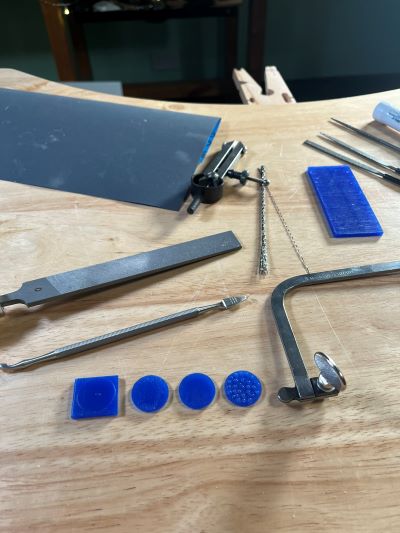
Tools for Precious Metal Clay

Tools for Precious Metal Clay

FIRING METHODS:

For Hob firing, stainless steel mesh with protection net.

Torch firing – Handheld torch and a firing brick (asbestos substitute not a household brick )

Kiln – If you can get access to a kiln then use it, the metal is normally denser and the results more consistant.

Stainless steel or brass brush – for brushing off the white post firing and leaving you lovely silver.

Silver polish & Cloth – for getting the final buffed up shine.

Some Optional Extras:

For ring making – A sliding ring guage, A wooden ring mandrel, and ring papers (to stop clay sticking to the mandrel).

For Better finishes – A small set of metal files for neatening edges quicker than sanding them down.

Long Tweezers – For holding / moving the pieces when firing

Liver of Sulpher – For antiquing or bringing out fine detail

Burnishers & ultra fine sanding pads – Post firing for a REAL shine!

Cutters & Shapers – Using pre-shaped cutters e.g. hearts will same time and give you more consistant shapes

Tiny drill bits – you can twist them in your fingers to drill through the unfired clay & make jump ring holes & hanging points.

Texture Mats/plates – Roll the clay out on these and you’ll have fabulous patterns straight away!

Letter Stamp Set – For stamping words into unfired (rubber stamps) or fired clay (metal stamps).

Why not check out our ready-assembled Starter Precious Metal Clay kit packed with everything you could possibley need to get started with PMC. Alternatively, if your not a PMC novice click here to view our full range of silver clay kits including our Art Clay kit and complete silver clay accessories kit, tumbler kit and tool kit.

Starter Kit for Precious Metal Clay

Starter Kit for Precious Metal Clay

Techniques, tools & processes used when filing precious metals

Tuesday, August 4th, 2009

We’d thought we’d look at some of the essential techniques, tools & processes used when filing precious metals – gold, silver & platinum.

Filing is an essential technique in jewellery making, and although simple in concept following proven practices combined with the right equipment and tools, ensures the job becomes a breeze.

Filing precious metals
Filing is used in jewellery making to remove excess metal, even out surfaces, smooth or to shape, form and texture pieces.

The actual files come in a variety of shapes, grades/cuts and sizes. The shape of the file you choose will depend on the job you are completing i.e. flat files are used for straight edges or convex curves e.g. the outer edge of a disc, and curved files are used on concave curves – e.g. inside of rings.

The cut describes the arrangement of teeth and therefore the amount of material the file will remove and the surface finish it will leave. The most often used, and useful file is a medium cut 2 file, (cut 0 = course, Cut 4 = fine) this general purpose file removes material quickly, and leaves only light markings which can be easily removed. 

Common types of file types
In terms of types of file, both needle and hand files are the most commonly used in jewellers workshops.  The common shapes of file are Flat files – a general use file for use on flat surfaces and outside curves, Square files for use in grooves or inside angles, Three square files for tight angles and difficult to reach areas, Round files for inside curves, Half round files for inside curves, Knife files for limited access corners, Crossing files for inside curves, Safety back files ideal for tight angles as serrated edge are only on one side.

Hand files - Range of over 150 available

Hand files - Range of over 150 available

Fitting a file handle
Needle files have an integral handle; however hand files often require a handle to be fitted. To fit your handle place the file in a vise with the ‘tang’ (where the handle is fitted) pointed upwards, then heat the tang until red hot ensuring you direct the flame upwards. Push the file handle onto the hot tang allowing the it burn into the handle. Then tap the handle with a mallet until the handle is secure.

Filing techniques for a straight line
When filing ensure that the metal is secured, as an unstable bench peg/metal will lead to inaccuracies and mistakes.  When filing a straight line use long strokes, applying pressure on the forward stroke. Make sure that the file is level and that you watch the metal to ensure accuracy plus allowing the jeweller to continually assess the pressure/placement of your next stroke. When filing you should work at a steady pace, as an aggressive technique increases the chance of inaccuracy. Many jewellers mark there metal as a guideline to measure progress and to see where they need to file.

Filing techniques for curves (convex)
With a flat faced file place the file on the metal and push forward using a sweeping action that follows the curve, ensuring the file is level. Use marks to guide the filing process, and check the surface whilst filing.

Files – an essential jewellery tool
Skilled filing is a key technique that once mastered gives the jeweller great control over shaping metal and forming designs. However initially it takes practice, concentration plus a level of intuition to ensure accurate lines or curves are achieved.  A complete jewellery tool kit will include a full selection of files – both needle and hand, of all shapes and sizes and cuts, and become some of the most used tools at the bench.

Post & WIN at Cooksongold’s Jewellery Making Blog

Tuesday, July 14th, 2009

Simply post a comment on Cooksongold’s Jewellery Making Supplies Blog for the chance to WIN a jewellery making kit. It’s as simple as that! Also don’t forget the more comments you post, the more chance you have of winning this fantastic prize. The competition runs until the end of October where the winner will be informed via e-mail as well as announced and featured on the blog and our NEW Jewellery Making Forum. For full terms and conditions visit the competitions category on the forum or click here.

Post and WIN at Cooksongold's Jewellery Making Blog

Post and WIN at Cooksongold's Jewellery Making Blog

Also why you’re here, check out our latest jewellery hints, tips and offers. Why not subscribe to of Jewellery Making blog RSS feed for fast and direct access to your desktop. Also view our other community facilities at Cooksongold.com by clicking the links below and see what we’ve been getting up to:

Have a question? Stop by the Cooksongold Knowledgebase and ask the experts: http://www.cooksongold.com/technical/

Join the conversation, start a new thread, share your wisdom and make new industry contacts, register on our Forum: http://www.cooksongold.com/forum/

Follow Cooksongold on twitter and ’stay in know’ with daily updates including latest articles, competitions and news: http://twitter.com/Cooksongold

Sign up for Cooksongold’s weekly e-mails including our latest offers and product launches: http://www.cooksongold.com/help/email_signup.jsp

Forming Tools & Equipment for Jewellery Making

Friday, June 19th, 2009

If you’d like to make a comment about this article, or post a question please click here

Forming metal is an essential part of jewellery making, and as a process the level of skill involved is often overlooked.  Forming refers to any process that maneuvers metal into the desired shape or design. Unlike many other skills in jewellery making forming is more a combination of a range of techniques that change an objects shape, rather than one particular process. 

Under the heading of forming are processes such as bending, chasing, repousse, sinking, hammering, using stamps/dies and forging.  These processes will affect the pieces shape, thickness and often the texture of the metal being worked on.

Forming Tools
The range of forming tools available is as wide and varied as the different processes contained within the skill.  The key forming tools available are:

Mallets
The simple mallet allows the craftsman to apply direct force without stretching or damaging the metal.  The head of the mallet is softer that the metal so not to mark the surface.

Mandrels or Triblets
Mandrels or Triblets are used for forming shapes, and are most associated with rings or bangles.  Mandrels are available in a variety size and shapes, and in both steel & wood.

Hammers
Hammers can complete a variety of jobs from stretching the metal, polish/smoothing or adding texture. Jobbing hammers are ideal for general use and metal forming. The planishing hammer is used for smoothing, shaping and polishing metal.  Riveting hammers are designed with a small head for detailed rivet work. Raising, bossing and chasing hammers are used in the different stages of forming.

Doming Blocks & Punches
Doming blocks & punches are the ideal way of shaping metal and making domed, shaped pieces or hollow beads. Pieces of circular metal/discs are place over the hollows of a doming block, and then using punches and a hammer the metal is formed into a shape. 

Steel Blocks
Steel blocks provide the ideal flat surface for working, flattening sheet or wire or to support work as it is raised or forged, riveted or textured.

Swage Blocks
Rather like doming blocks, Swage blocks help form metal into tubes, curves and channels.  Different blocks will allow different shapes and sizes to be formed.

Sandbag / Grit filled Cushion
These bags provided support whilst you work and form your piece. They help keep your work firm and in place whilst working.

Pliers
Pliers have a multitude of uses but they are the most basic tool for holding/gripping, forming and shaping wire.  Having a basic selection of needle nose, round nose, flat nose, half round and a pair of parallel action pliers, will give the jeweller the flexibility to complete most jobs.

Stakes
Often used by silversmiths, the metal is placed over the stakes (usually clamped independently into a vice) and hammered to achieve the shape required. Various shapes can be achieved by using different stakes.

Files
Files are essential for removing excess material, and fine tuning and shaping your piece.  The different sizes available allow the jeweller to work large areas or at a more intricate level. To start with buy a selection of shapes containing round, square, triangular, half round and warding.  Plus consider the cut ranging from 0 the coarsest, to 6 the finest.

Draw plates
Draw plates are most commonly used to reduce the size or change shape of wire. Each plate has a series of holes through which the wire is passed through, this then changes the size of the wire. The holes in the plate are of decreasing size allowing you to continue draw down the wire to the required size.

Rolling mills
These larger machines often seen in jewellers’ workshops are ideal to reduce the thickness of sheet, or help decorate sheet. If used with Square and D shape sections rolling mills can be used to form or shape wire. 

This selection of forming tools & equipment allow jewellers, and metalsmiths to create any number of shapes, textures and patterns.  As with all jewellery projects the range of forming tools jewellers have will start with the basic i.e. pliers, hammer and perhaps a doming set, and then expand as their projects demand.

Forming Tools

Forming Tools

CLICK HERE TO MAKE A COMMENT, POST A COMMUNAL QUESTION OR ASK THE COOKSON TEAM A QUESTION

Rolling Mill – Milling Silver & Gold Sheet & Wire

Tuesday, May 12th, 2009


If you’d like to make a comment about this article, or post a question please click here

STOP PRESS – We’ve just dropped the price of ALL our rolling mills, and to co-inside with this new offer we thought…
 

Rolling Mills – Basic Concepts

Rolling mills are one of the more common jeweller’s tools seen in small and medium sized workshops. In essence the rolling mill is a simple machine that shares many traits with a mangle. The traditional jewellers rolling mill will have steel rollers, so that when metal is passed between them it become compressed, changing the gauge or even shape of the piece. For example changing a circle into an oval shape.  


As a rough guide when halving the thickness of sheet you will double the length (if rolling in one direction). Rolling should be a gradual process, and the resulting compression of the metal will mean that the metal will work harden. Therefore in between each stage of rolling, the metal will need to be annealed.


In addition to rolling sheet many of today’s mills have the ability to roll wires into square or D shape sections – ideal for creating a tapered or shaped effect.


Smaller rolling mills are the most practical for the small or home workshop with one pair of rollers. Larger and automatic mills are available for the larger workshop, but with all mills they must be secured to a firm and steady surface – and many manufacturers recommend a dedicated stand bolted to the floor.


Rolling Sheet

First ensure your sheet is prepared for rolling i.e. it’s has been annealed, and cleaned, and importantly dried. Then adjust the width of the rollers, many machines have a dial gauge to aid precise rolling gap measurement. As a physical test try pushing the sheet between the rollers. If the sheet passes through, the rollers should be adjusted until it will not pass between them.


Once the rollers are in the correct position the mill is ready to roll down the metal. The sheet should be supported in one hand, whilst the other turns the handle, thus drawing the sheet through the rollers.  The sheet should be caught as it comes through, and thickness checked using a vernier/calliper.  Then re-roll to achieve the required thickness.


Rolling Silver circles to create Ovals

To create an oval take a silver disc, set the rollers as you would for rolling sheet, and then feed the disc through. Once the disc has been through the mill, check the thickness and length of the piece using a vernier/calliper, and repeat the process as necessary. When feeding the oval through the mill again, ensure that it is fed through the rollers in the same direction to ensure it elongates the oval.


Shaping Wire

Using a rolling mill with square grooves allows jewellers to shape (often into a square shape) and taper round wires. Before starting the process the wire must be annealed, pickled and cleaned and dried thoroughly. The wire is then pushed between the square grooves and the handled turned so the wire is drawn into the grooved section of the rollers. This then shapes the wire. To ensure the required shape is achieved turn the wire each time by 90 degrees.


Formed D Shape wire

Rolling mills with D shape channels allow D shape wire to be formed, and follow similar principals as shaping. The wire is fed through the D shape section rollers and once the wire has passed through check the thickness. If it is not of the required thickness repeat the process.


Best practice when using rolling mills

When using a rolling mill consider the following best practice hints & tips:

           Always use dry metal – any dampness will leave marks on the rollers
             – and risking pitting.

           Roll metal gradually, as too much pressure may result in the piece�
            cracking when next annealing.

           Keep your mill well maintained and oiled.

           Remove any marks on the rollers. Clean with a damp cloth and�
            acetone to remove dirt. For more stubborn marks carefully remove
            with fine wet and dry paper and fine steel wool.

           Keep the mill covered when not in use, to protect the rollers
            from workshop debris.

Click here to view our range of rolling mills

Click here to view our range of rolling mills

Rolling Mills are one of the more expensive jeweller’s tools, and although simple in nature the mill can be put to many uses. When buying a mill, like many tools you should buy the best mill you can afford, with the better mills being more robust and having heavier and stronger rollers.

CLICK HERE TO MAKE A COMMENT, POST A COMMUNAL QUESTION OR ASK THE COOKSON TEAM A QUESTION