Archive for the ‘Uncategorized’ Category

Summer Trends 2013

Monday, May 20th, 2013

Looking for the hottest summer trends? You’re in the right place. From vintage inspired to bold graphic prints, we’ve rounded up the key looks for next season. Blog article written by Joanna Varney.

Great Gatsby

It’s finally upon us.  Opening in the UK this May, The Great Gatsby which celebrates the glorious excess of the 1920s has been largely responsible for an emerging trend for all things ‘flapper’ for what seems like an age now. As the film opens the trend will undoubtedly peak so don’t write off those bejewelled headpieces just yet! Look out for pearls in abundance alongside multi functional brooches using delicate imagery of flowers, feathers and insects. And don’t forget the all important tassels and fringing which were so abundant during this era. Anyone still in any doubt as to the influence of the 20s today simply needs to take a look around your nearest high street or shopping centre. It has been and still is huge!

Flapper-DressFlapper-Necklace

Strong, clean cut Art Deco imagery has come through with great significance this season, alongside powerful tribal inspired designs which have been prevalent for a few years now.  The two actually seem to merge quite well together which is surprising. There are masses and masses of Inca inspired collars and cuffs to choose from and the scale is huge.  Some stores are even displaying their neckpieces on coat hangers they are that big! Without a doubt, the ‘must have’ jewellery item this year has got to be the statement necklace.

Macrame-Necklace

Of course the other big story in jewellery this year has been the spike. Be it hard metallic studs or slightly more subtle triangles, it is a shape which lends itself particularly well to neckpieces in either repeater, collar like styles or stand alone pendants.

In terms of colour, I have not seen so much of the Emerald (Pantone colour of the year) as I would have expected. Instead, the colour coming through most strongly is the tangerine/orange colour of 2012. (Perhaps Pantone were a little ahead of their time!). Often softened with monochrome, hot tones of coral, orange and peach are high profile in most of the fashion conscious retailers.

Monochrome has become a classic combo which enjoys reinvention year after year and this summer is no exception. Bold stripes and prints are the order of the day and provide a cooling backdrop to some of the other jaw dropping hues available at the moment. Neon’s, particularly yellow, pink and blue are strong in accessories and are generally sports themed and clean cut. For most people over 20, neon’s are dangerous territory and I think retailers have realised that in the main, their buying public are not as brave as some of the celebrities pictured in neon yellow at the beginning of the year. Accessories (jewellery included) are a safe way in to this trend for all those non-teens!

Neon-Satchell

Finally a word on summer florals. Many of us like to indulge in something a little lighter and brighter to wear on our long awaited summer holidays. (Male and female) So you would expect to see floral sarongs and haiwaiin shirts a plenty as you stroll around the shops. But this year floral prints have quite literally exploded onto fashion and accessories and not in a literal depiction. No, this year things are a little more ‘chemically enhanced’ (for want of a better description) but to great effect. Blurred and smudged, distorted and fanciful, these are not so much shrinking violets but shouting from the rooftops loud and proud!

Floral-Trends

In fact ‘loud and proud’ is quite an apt way to sum up this summers’ trends and that includes jewellery and accessories as well as clothes. There are so many strong design elements around this year that it’s almost as though they are all fighting against each other for the limelight. Taken in its entirety, it is far too overpowering, but it is packed full of inspiration and ideas for anyone wanting to design.

How to make a simple Double Gallery Setting

Monday, April 29th, 2013

A ‘How To’ guide by guest blogger Lydia Niziblian.

A lady came to me with an antique heart-shaped amethyst that had been cut by a relative who was an amateur faceter.  It was very unevenly cut, but of great sentimental value.  It needed a handmade setting, and I thought a double gallery setting would be perfect, as it would hold the deep stone, and make the most of its colour.  Armed with some tips from the Cookson Gold forum, I was off!

Equipment: Torch, flux, brush, pickle, pliers, bench stake, hammer, piercing saw, needle files, emery paper.

Materials: Sterling silver wire, silver solder of varying grades.


Using 1.0mm sterling silver wire, I formed the first shape. This fit just under the girdle of the stone.  When the stone is placed on top of the shape, it should sit neatly, with no gaps apparent between the edge of the stone and the silver.

When I was happy with the shape, I cut the wire. Then I double checked the seat of the stone   before soldering with hard solder. I then hammered it flat on my bench stake to make it as even as possible.

SAMSUNG DIGITAL CAMERA

Now the smaller shaped heart needed to be made. I formed this for the lowermost point of the stone to sit in.  If you sit the stone in the larger piece, make sure the smaller piece will seat the bottom of the stone, without the stone protruding through.  As before, it was cut, soldered with hard solder, and hammered flat for as even a seat as  possible.

SAMSUNG DIGITAL CAMERA

I then made  a cross with two lengths of wire.  I left plenty of length, as these were going to form the prongs that held the stone in place.  I soldered them at the cross point.   I then placed the smaller of the two hearts onto the cross.  This was soldered into place using medium solder.

SAMSUNG DIGITAL CAMERA

Using a piercing saw, I cut the cross away from the centre of the heart, and filed the edges smooth.  Then it was time to place the second supporting heart.  It was a little fiddly, but by angling the prong  arms correctly, the heart sat neatly with even spacing below.  I soldered it in place with medium solder.  A little binding wire might be good insurance against any movement during soldering here!

SAMSUNG DIGITAL CAMERA

Once the soldering was complete, I double checked the seat of the stone.

SAMSUNG DIGITAL CAMERA

SAMSUNG DIGITAL CAMERA

Once I had had a look at the stone in place, I could mark and trim the prongs to a more workable length.

SAMSUNG DIGITAL CAMERA

I then used easy solder and soldered the setting onto the ring shank I had made.

SAMSUNG DIGITAL CAMERA

Again I tested the seat of the stone, before marking and trimming the prongs to my desired final length, and pickling the piece.

SAMSUNG DIGITAL CAMERA

With a marker pen, I marked where the prongs needed to bend over the stone.  With the stone out, I used a triangular needle file to carefully file a tiny notch at this point on each prong.  Finally, the prong ends were shaped and filed smooth and the ring cleaned and polished thoroughly.

10

With the stone in position, and the ring held in a ring clamp, I carefully bent the prongs over.Moving each a little at a time ensures the stone stays tight and central throughout.  You can see that despite the uneven cut of the stone’s girdle, it was seated firmly, and held securely.

SAMSUNG DIGITAL CAMERA

Jewellery Making Q&A with Amy Logan

Friday, April 26th, 2013

On Wednesday jewellery Amy Logan hosted a live Q&A on our Facebook page. We had some many great questions that we thought we would post an article so that these great tips aren’t lost in the depths of our timeline. Thank you once again to everyone who took part, it was so great to chat to you all!

Question: I’m having a little bit of trouble deciding with which thickness of saw blades I should be using. Do you have any advice or tips I could you?

Answer: My favourite saw blade grade is 3/0 as I like to use a thin grade. Most tutors will advise that you use a 2/0 as it is right in the middle and good for most thicknesses. One tip you can use is that three teeth of the blade should cover the thickness of the metal you are using.


Question: Can you tell me if the eco silver from Cooksongold can be sold and stamped as .925 sterling silver and what are there any advantages and disadvantages of using it?

Answer: Eco silver is the same alloy make up as standard .925 but the great thing about it is that it’s 100% recycled. This means that for customers concerned about the environment there is a fab ‘greener’ solution for them. You will find that working with Ecosilver is exactly the same so you won’t need to change your making process.


Question: I need to do some very delicate soldering, is there anything I can buy to help me keep the flame very same and thin? I keep making mistakes with a regular torch.

Answer: For delicate items I actually love to use a hand torch – they are not very powerful which will work to your advantage with thin silver. Have you also tried rolling down your solder? If you make it super thin it melts much quicker meaning you don’t need to heat the piece for as long, this reduces the risk of melting and the chance of any fire stain.


Question: Do you have any tips for working with/soldering brass? Someone told me the fumes are toxic but I can’t find any information regarding that online! Also what is the best way to pickle it?

 Answer: It is most probably the flux often used to solder Brass that they are referring to -generally these can be quite toxic. I would recommend that you use the Borax as this is basically a mineral ground up and compressed into a cone. I would still say you should be working a well ventilated area but it is definitely much safer. Then I would go for the Picklean Safety Pickle as it is a food grade material and also much safer than other pickle powders. Ideally needs to be warm – if you can’t splash out on a pickle unit I would suggest a bain-marie type set up to help with a more constant temperature.


Question: I’ve been working with silver plated copper wire and have just started with sterling silver. I’m finding it very soft, is there anything I can do to strengthen it? And is there a breaking point with sterling silver wire and if so, how will I know when I’m near it?

Answer: There is a breaking point at which you can crack silver when you have work hardened it. Here’s an example: if you are raising a bowl, the metal gets harder the more it is hammered, this is because the silver is being squashed as its being stretched. You will be able to tell from the feel and the ‘spring’ in the silver – if you are unsure its best to anneal before continuing so you don’t damage the silver. Hammering is the simplest way to harden silver. If you are using wire – for example you have just soldered on earring pins you will find the wire is quite pliable. One of the best ways I find is to place the item in a barrelling machine and tumble it for a couple of hours – it will come out shiny and with a nice springy back to the earring.


Question: I have just started out and no idea what grade wet and dry to start with. Don’t really want to order one of each, can you help?

Answer: For best results it is good practice to go through each grade – however, you can skip a few. So depending on the scratches you are trying to remove you may not need a very coarse paper one to start as you will actually be putting in more scratches than you are removing. A good grade to start with for deeply scratched metal is 240 for lighter scratches I tend to start at around 400.

The Jeweler’s Bench Reference

Monday, April 15th, 2013

A review of ‘The Jeweler’s Bench Reference’ by Harold O’Connor.

Jewellers Bench Reference

‘An essential purchase for anyone looking to improve and perfect their working techniques.’

I have found this book to be quite surprising in a number of ways. When it arrived in the post I was a little taken aback as to how small it actually was.  I removed the layers of outer packaging to reveal a tiny little ring bound text with stiff plastic covers which measured a very meagre 11.5 x 18cm!! Surprise number one.

On my initial flick through the book I discovered a complete lack of any sort of narrative. There is no introduction, but instead a paragraph about how the book is intended to be used, along with some information about the author. Following this is a list of other available books and then you are straight into the text without warning. To be honest I expected chapters or at least some clear division between subjects but this is not how this book works. Surprise number two!

The subjects covered in this book are simply arranged in a list format, with one running into the other barely pausing for breath.  If you go back to the contents page, (Design, Parts, Stone setting, Rolling, Annealing, Sawing and Filing, Soldering, Alloying, Casting, Repousse and Etching,  Coloring, Enameling, Reticulation, Mokume, Plating, Photo Etching, Flexshaft, Finishing, Tools, Chemicals and Materials, Commission Charts, Measurement Conversions, Index)the list is there with corresponding page numbers but there is literally no more explanation than that. It is when you read the ‘About this Book’ paragraph that the penny really drops.

This is a book about efficiency. It is essentially a professional jeweller’s notebook which contains those nuggets of information which will help to encourage best working practise. It is intended to be kept either at the bench or in the tool box and is jam packed with information and formulas that will help you to work in a more precise and accurate way. There are no glossy photos, just simple line drawings which can be a little hard to read in places and much of the technical data takes time to absorb. Also many of the techniques are quite advanced so I would suggest that this is not really suitable for a beginner. But for a person looking to improve and perfect, this would be ideal.

I was pleasantly surprised to read about some of the less documented topics in metalwork such as Alloying, Rolling and Photo Etching (if a little baffled in places!) Never before have I read a book which covers Alloying in such detail. O’Connor actually describes how you can turn 14k gold into 18k gold (no he’s not an Alchemist!) and has also included a table which details the metal composition in grams, of every colour of precious metal! A step too far for some I’m sure but fascinating none the less.

For me some of the most useful information was in the Design section right at the beginning of the book. Things like: Finding the proper length of a Ring Blank and Computing the Amount of Metal Needed to Make a Constructed Object. This is basic but essential information that you need to hand if like me you can’t remember formulas easily.

To sum up I would say that this is not a book for someone looking for a leisurely read. What it is though, is a hardworking, ‘go to’ bench reference notebook (as the title would suggest) that you will turn to again and again and again and is an essential purchase for anyone looking to improve and perfect their working techniques.

New Formula Art Clay Review

Monday, March 18th, 2013

Take a look at this New Forumla Art Clay review  by guest blogger Sarah from Oberon Jewellery.

I have worked with PMC, Art Clay Silver 650 and Art Clay Silver Slow dry in the past, 650 being my favourite. I’m on a very limited budget so don’t have a kiln, I hob fire then re-fire with a blow torch having found that that gives a much stronger finish.

I have to say I was very excited about using the new clay. I did three designs to test different aspects of the clay, one very simple design to test the overall finish, one design that needed lots of drilling to test the strength and lastly one design that was layered and complex to test the workability.

The Sketches…

Sketch

Sketches

Workability

Templates all cut out and ready to go…let the fun begin!

Design Templates

Templates-2

And what fun it is!  I have always preferred the workability of 650, oddly I find it stays workable longer than slow dry. The new clay works beautifully wet, doesn’t get that crispy thing going on around the edges if you take too long rolling it out, this was particularly good for the pristine roll out needed for the Ray. In addition it was also very flexible for the more complex tattoo style bird that was multiple layers of clay. I did treat myself to some of the new paste too, to glue and finish the pieces before firing. I found the paste a little too ‘sticky’ so to speak but this was easily sorted with a quick spritz of water, it left a lovely finish but was definitely less easy to work with than the 650 paste. Although the clay stays workable for a good length of time it didn’t take too long to dry to a point that you could start finishing it with files and sandpaper. It reacted well to using the little hot plate I had too the speed up the drying of filling and paste that was needed on the bird prior to filing. The ray needed very little finishing, just a quick file and sand to smooth the edges and was much less fragile than the 650. It also drilled really well on all the holes needed in the articulated lizard, only one crack and that was wholly stupidity on my part! The clay worked so nicely for the birds layers (five in all), not too floppy so it sort of caved in but kept its form well whilst letting me fiddle around with it. Filing and sanding were a dream and gave a beautiful finish as you can see…

Prior to finishing…

Prior-to-finishing

All finished and ready to fire…

Ready-to-fire

Once they were all finished it was time to fire, they hob fired perfectly (for ten minutes), no little bubbles popping up and very few splits in the layers that needed filing and refiring. I then did my usual three minute peachy glow torch fire, the skinny bits seemed a little less prone to starting to melt which was great on the ray and the tail of the lizard.

Firing…

Firing the piecesNext is a quick brush down with a wire brush and a dunk in the liver of sulphur for patina… This looks horrific, taking fabulous shiny pieces and turning them pitch black….

Oops!

Oops

I also decided to test how well Keum Boo worked using the lizard for this (obviously prior to brushing and liver of sulphur). This I think was slightly easier, the gold seemed to adhere with slightly less hassle and work and the results looked good.

The only real negative I could find was it did not seem to polish up quite as well after turning black. I certainly found it harder to get a good clean shine, it was a flatter surface to work with but removing the excess patina was really hard. That said once it was done it came up beautifully. The other thing that may be link to that was the silver seems harder which in most ways is a good thing, it didn’t scratch as easily if I slipped with the burnisher (and if it did scratch it was harder to get rid of!) either. Re-drilling any holes to enlarge them was harder but the pieces definitely felt sturdier, again good with those long tails.

All ready to turn into actual jewellery…

Ready To Go

So all in all it’s a big thumbs up for the New Formula Art Clay (a little extra polishing is no bad thing, great for the bingo wings…) and thank you so much for letting me review the product.

A 4.75 stars from me, well to be honest a 5 star review as I would rather all the plusses than the one minor minus.

Finished Piece One Finished Piece Two

Finished Piece Three

www.oberonjewellery.com

http://www.facebook.com/OberonSilverJewellery

Jewellery Designers experience new DMLS technology.

Monday, February 18th, 2013

Together in partnership with EOS we have created the new Precious M 080 Direct Metal Laser Sintering machine an innovation that produces top-quality precious metal parts direct from 3D CAD data, fully automatically. Our unique ‘end-to-end’ manufacturing process offers everything from Machine sales, Powder sales, bureau service to training and maintenance allowing you to make your most extraordinary jewellery making dreams become a reality.

As a designer you may have some ideas that are too expensive or too difficult to execute, it’s our mission to help you make the impossible possible. We can take the most complex of concepts to a ready to finish product without the requirement for tooling, moulds or milling path programming. Saving you time, money and preventing waste.

Last week, we had a collection of established designers from London and Birmingham to come and experience this revolutionary technology first hand.

They got to see our machine in action, producing these intricate 18 carat cufflinks.

Cufflinks-2 Cufflinks-1

 Designed by Digital Forming.


We had some really great feedback about the Precious M80 from the designers who visited us and would like to thank them all for their attendance.

Designers:

Martyn Pugh www.martynpugh.co.uk

Andrew Macgowan www.andrew-macgowan.co.uk

Kevin Grey www.kevingrey.co.uk 

Becca Williams  www.beccawilliams.co.uk

Alan Craxford www.alancraxford.com

Victoria Harper

If you would like more information on DMLS click here.  Or to find out more about our new Precious M80 laser sintering machine click here.


Designer of the Month: Kim Styles

Wednesday, February 1st, 2012

It was while doing a one year 3D foundation course that my tutor suggested I might be good at jewellery. I had grown up in an engineering background and although I hadn’t considered jewellery before, I am very grateful for her insight, as she was right!

I applied and was amazed to be accepted to do a degree in ‘Jewellery, Silversmithing and Allied Crafts’ at Sir John Cass in London.  The course included two placements in the trade.  I graduated with an honours degree in 1987 and was invited to work for one of the jewellery manufacturing  firms I had done my placement with.  I worked as a goldsmith there for several years, doing all manner of work, setting, polishing, occasionally designing.   It was while I was there that I was held up in an armed raid and although I was physically unharmed, it has had a bearing on the person I am today.

After being married for a couple of years I sadly suffered an early miscarriage and decided to leave the environment of the jewellery company as chemicals are a necessary part of jewellery production and I didn’t want to jeopardise any further pregnancy.  I continued to make jewellery from a small bench I fashioned from a plank screwed to the wall at home, but only for myself and friends.  I even took jewellery classes so that I could have access to equipment, but ended up helping out the class tutor!

I did indeed have a daughter and jewellery took a back seat until we moved to Devon when she was two. A couple of years later I had my son. Then I gradually started making again, I did jewellery parties for friends, and bought myself some equipment; my bench and a polishing machine.  I still had all my old tools, several handed down from my father, a treasured Archimedes drill and an ancient tool box.  I was determined to continue without borrowing money, which restricted my progress I think.

I started sketching again, photographing everything that caught my eye, getting out and about in the beautiful surroundings.

This pendant was inspired by the small stones jammed into a pebble on the beach.

I took a job data inputting for few years to help make ends meet, but for someone creative it was mind numbing.  I started doing local craft fairs at weekends, all the time getting my old skills back up to scratch.

This Nobble ring was inspired by a rubber finger protector I used while data inputting!  I always kept a notebook, or envelope handy to sketch ideas.

Then a work friend heard of someone looking for a local jeweller to be part of a co-operative gallery.  It seemed a good opportunity for me to make a go of it with my jewellery so I handed in my notice and thought I was back on track as a jeweller.  I got my jewellery into various local galleries and worked one day a week in the co-operative.  The beginning of a recession was never going to be the best time to start up as a jeweller!

I took my jewellery up to London for Liberties ‘Open Design Call’ which was an experience and one that I am glad I did.  I had a positive response although it didn’t lead to anything.

I was doing regular craft fairs but often not covering the cost of the table.  Which meant I had less to spend on the next fair and so on. I found some occasional ’piece work’ with a local jeweller, which got me back into the small factory set up again, which felt rather like home.  So my work skills have grown as I can work on items all the way through the casting process from model making, mold making,  waxing to finished set and polished casting.

Pair of silver rings over laid with 18ct gold and set with a 3.9ml diamond

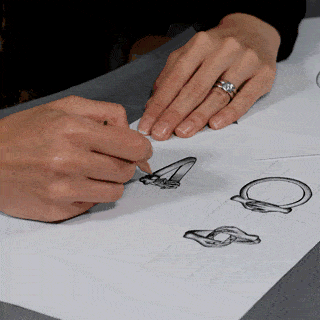
I love what I do, I am always making something, often with bits of scrap.  I have a website which performs poorly, despite my best efforts, yet again hampered by lack of funds to invest in a better one.  I have concentrated on enlarging my web presence in the last year and am active on social websites, which has seen interest in my designs grow.  I enter any competitions I can find and have just recently won a new pendant dill, courtesy of Cooksons’s Gold forum theme competitions.  Just in the nick of time as my old one was about to pack up completely!  I work very much in the old fashioned way, no flashy computer design for me, I prefer a pencil and a bit of paper.  I do the occasional commission, and last December I made my first engagement ring, which was a joy to do.

Hand cut and formed baby and flowers engagement ring, set with two diamonds.


Pierced 9ct gold mistletoe and vine necklace wit silver berries.

I am not sure what this next year will bring, but having come so far and tried for so long, I don’t want to give up on something I enjoy doing so much.

To see more of Kim’s beautiful designs, visit: www.stylesdesign.co.uk