Archive for July, 2011

Get to Know your Findings: Focus on Earrings Part 2

Wednesday, July 27th, 2011

Nothing says ‘Glamour’ like a pair of drop earring.  Unlike their safer, more sensible counterpart, the stud, long drops are made to be noticed! If the fashion press are to be believed, drop earrings, specifically the ‘chandelier’ style, go in and out of fashion on a regular basis. What can be more elegant than a pair of linear drop earrings? They go with most outfits and flatter all women as they add length to the neck. Note: by linear I mean a single vertical drop, usually straight, but sometimes curved. You will also find that by displaying pairs of drop earrings within your range, you add height and interest which will entice your customer. You always need more flamboyant items to capture people’s attention. This will help you start the conversation around the jewellery which, more often than not, will then convert into a sale.

As with a stud, to get a drop earring fully functional and comfortable there are a few crucial points that need to be considered.

1. First and foremost the weight: many people are put off by large drop earrings because they think they will be uncomfortable. However it’s all a question of balance. Try to consider your choice of materials. Use thinner gauges of metal, hollow beads and tube instead of wire; and don’t always assume you have to use a hook fitting. It can often be far more appropriate to use a stud fitting which will ultimately provide more support for the ear, provided you use an adequate scroll (see Focus on earrings Part 1). A Bead and Ring pin (French Fitting) is a great option: a classic ball stud with a simple open loop underneath allowing you to simply add your earring design. Just remember to consider the position of your loop or jump ring to ensure the design is front facing.

2. If you are using crystals in your designs try using a Crystal Stud Fitting. It’s always more aesthetically pleasing if you can carry the  design element through into your earring fittings, it creates a far nicer end result and sets a handmade item apart from a mass produced one.


To create a completely “handmade” earring, you can make both the design and the fitting yourself.  Hook fittings are extremely easy to make:

  • Select your wire, usually 0.8mm as standard;
  • Anneal to ensure flexibility: it is best  to carry this out in a darkened room. Annealing is the gentle heating of metal to alter the cell structure, creating more flexibility. Silver should be very gently heated using a torch. Keep the torch moving constantly until the metal becomes a dull, cherry red. Maintain this colour for approximatively 30 seconds. DO NOT OVERHEAT.  Gently cool on a metal plate;
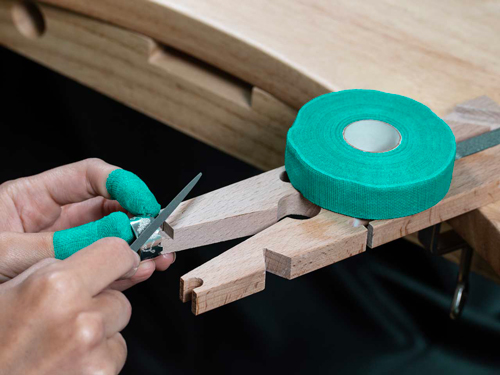
  • You can either heat the end of the wire to create a ball, or simply flatten with a file to create a good solder surface;
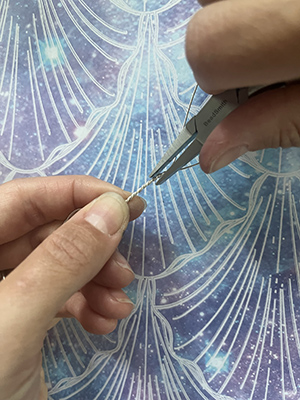
  • Using round nosed pliers at the tip, gently bend the wire back on itself to create a tight loop;
  • Using the same pliers at their widest point, bend the wire back the opposite way to create the main sweep of the fitting;
  • Simply cut the wire to the required length, round off to a smooth end and straighten and twist to create a nice finish using flat pliers. Note, twisting helps to compact the cell structure of the metal which effectively gently hardens the fitting. Where the annealing process relaxes the metal structure allowing more movement, twisting, bending and flattening compacts that structure allowing less movement;
  • Once attached to your design, solder the small loop closed to create a safe strong fitting.

If you don’t fancy making your own fittings or you don’t have the time, you can always buy one from the trade that will complement your style. You can always try simple fittings such as Hook Wire with Bead and Loop or Extra Large Safety Wire. Both of these styles are well finished and have a designer look about them.


3. One final tip: an essential element to jewellery making is wear ability. Never forget that however beautiful your jewellery is, its purpose is to be worn. Metal can be extremely sharp and if a sharp object is swinging around in your ear, you will soon have the tell tale scratches to highlight any bad workmanship. To ensure this never happens, whenever you finish a piece,  just take a few moments to hold the item in your hands. Close your eyes and run your fingers over the jewellery to check for any rough or sharp edges. You’ll be surprised at what might be revealed. You may feel a bit silly, but it may prevent any embarrassing returns from your customers!

Get to Know your Findings: Focus on Earrings Part 1

Monday, July 18th, 2011

Earrings, (essentially for pierced ears) make up the second biggest product area on the high street, narrowly beaten only by stone set rings. It is a vital area to be in, if you are considering selling your jewellery commercially as they sell extremely easily. They make great presents as there is no sizing to consider, but they are also a fantastic self purchase for women, most of whom wear earrings every day. Get your pricing right and you will find that earrings quickly start to constitute the ‘bread and butter’ of your range, generating regular revenue that will allow you to indulge in making more elaborate pieces.


Generally speaking, studs far out sell drop earrings. They are a practical, everyday option that are easy to wear as long as the scale is kept small. Virtually any design can be quickly transformed into a stud earring, but whilst the aesthetics are limitless, there are a few practical points to remember to ensure your earrings are fully functional and wearable:

  1. Firstly the weight of the earring needs to be considered. You want the design to sit flat against the lobe of the ear so the scroll that you use needs to be of sufficient size and strength to support it. (Cookson  offer a wide range of scrolls from extra light to extra large suitable for most styles of stud). Try to ensure the size of your design is balanced by the size of the scroll.
  2. It is also worth considering using plastic backs as an alternative or additional option for your customer.  Plastic backs with base metal offer great support for a heavy earring. You can find them here and here.  They are also a more cost-effective solution if you are find price to be an issue. Customers with any allergies can also use these backs as they contain surgical grade metal. Alternatively, if you are concerned about putting a base metal finding on a silver earring, you can find a silver version here. But note that if you are designing jewellery for children, plastic backs are a must from a health and safety point of view. You might find these plastic ear backs more suitable.
  3. The positioning of the earring pin or post on a design is a key consideration. If the design is small enough I would always ensure the post is kept central which in turn keeps the earring in the right place on the ear. Your clients will not want to be worrying about repositioning jewellery throughout the day.  A larger design might require a post positioned more towards the top, allowing the piece to hang down slightly. On average, posts tend to be 0.8mm – 1mm diameter and come in a range of lengths. You might find the shorter lengths easier to solder. It is crucial you check what size hole your scrolls have before soldering on your posts as they are not all the same and although there is a certain degree of flexibility, you need a good grip on the post otherwise your earrings will fall out! It is worth pointing out that sometimes the larger pins (1mm) can be uncomfortable for some people to wear, so you might want to stick to the 0.8mm standard. Headed pins provide a greater surface area for a good join, but don’t look as clean as the plain version. (A good test of a solder join is to twist the soldered post firmly 180 degrees with a pair of flat pliers. This will quickly reveal a ‘dry joint’ if your solder has not run properly but will also semi harden the post after it’s been heated making it a little stronger).

You can of course make your own pins by using wire of the correct gauge. Simply smooth and round the end of the wire, file a groove approximatively 4mm from the end to locate the scroll and then cut to length. The end will need flattening to ensure a good join.

Although many of the points in here may seem obvious to people who have been making earrings for some time,  for the beginner these are basics that could easily be overlooked. Remembering a few basic guidelines will ensure your reputation with customers and have them coming back for more!

How to Series: PMC Stamp and Cut Pendant

Friday, July 15th, 2011

STAMP AND CUT: An effective but simple project for Precious Metal Clay in association with PMC. Design this pendant in only 7 steps!

You will need:

STEP 1

Roll out some Precious Metal Clay on a piece of Teflon sheet using a Spacer Roller set. Remember to lightly apply Badger Balm to your tools to prevent your clay sticking.

STEP 2

Use a texture mat to add texture to both sides of your Clay.

STEP 3

Cut out 2 circles that are the same size. Cut a large oval in the centre of 1 circle. Cut a small circle near the top of the second circle.

STEP 4

Leave the pieces to dry thoroughly and then use sandpaper to refine the edges.

STEP 5

Torch fire each piece. Torch fire for a minimum of 2 minutes, time this from after the binder has burnt off and the piece starts to glow orange.

STEP 6

Polish using a Stainless steel brush and Burnisher.

STEP 7

To bring out the depth in the piece use an antiquing solution such as Liver of Sulphur or Platinol. Use the agate burnisher when the solution is dry to bring up the highlights on the piece. Loop a piece of cord around the top of both circles and your pendant is ready to wear.


How to Series: Chunky Charm Bracelet by Jane Kharade

Monday, July 4th, 2011

This is a guest project designed by Jane Kharade. Jane is a craft designer who designs beautifully coloured pieces with the aid of clay, crystals and silver.


Summer Shapes bracelet

You will need:

Tools

STEP 1

Carefully cut out four shapes from medium weight card. Use a 10A scalpel blade and a cutting mat then trim the card down on each one.

Step 1

STEP 2

Roll out the PMC3 clay to approximately 1.5mm on a Teflon mat. Use a plastic roller, and two spacers to roll the clay to an even thickness. Lightly dust the Fleur De Lys rubber stamp with talcum powder and carefully but firmly press the PMC onto the stamp.
Step 2STEP 3

Carefully peel the PMC from the rubber stamp and lay it on the Teflon mat. Gently place the card template on top of the PMC and cut out the clay with a scalpel. Work quickly and cut out seven shapes in total, you may wish do make a couple of spares; choose the better ones for the bracelet and the spares can be made into pendants.

Step 3

STEP 4

Use a 7mm Ø paintbrush protector and cut out a circle from the centre of each shape. Roll the clay into a ball and wrap it up immediately as it can be re-used.

STEP 5

Use a sharp instrument to make a hole in each charm for hanging.

Step 4

STEP 6

Use a needle file to file all the rough edges on the charms, do this while the PMC is in its ‘dried out plaster’ state. The task will be time consuming once the PMC has been fired and is metal.

Step 6STEP 7

Fire the charms on a soldering block with a hand held blow torch. Make sure they glow steadily pale orange all over. Begin timing for 2.5 minutes – enough for pieces under 10g. This stage is known as ‘sintering’. Don’t worry if the charms become curved during firing. Simply leave them curved as I have or turn them over with tweezers and re-fire.

Step 7STEP 8

Oxidise the charms in a solution of Liver of Sulphur; use it in a well ventilated room as the fumes can be dangerous.

Step 8

STEP 9

Polish the charms with emery paper, as the PMC is soft fine and extra fine will be sufficient to create a polished surface. Finish off by burnishing them with a metal burnisher.

Step 9STEP 10

Use pliers and add a 5mm jump ring to either end of a silver curb bracelet. Thread on the ring and bar and attach a 7mm jump ring to each charm and hang them from the bracelet. Make sure all of the jump rings are tightly closed. You have finished your Chunky Charm bracelet!

Step 10

Designer Tip

Peel a little part of the clay away from the stamp and check that a good impression has been made in the clay. If the impression is weak simply apply more pressure to the clay with the fingers.

Make sure the holes made the charms for hanging will be big enough. As the charm shrinks during firing so will the holes.

Hope you enjoy the project and let us know what inspires you this summer!